
AI Agents & Blockchain: Decentralized Autonomous Intelligence
Explore how AI agents leverage blockchain for enhanced trust, security, and verifiable autonomy. Discover applications, challenges, and the future of decentralized AI.
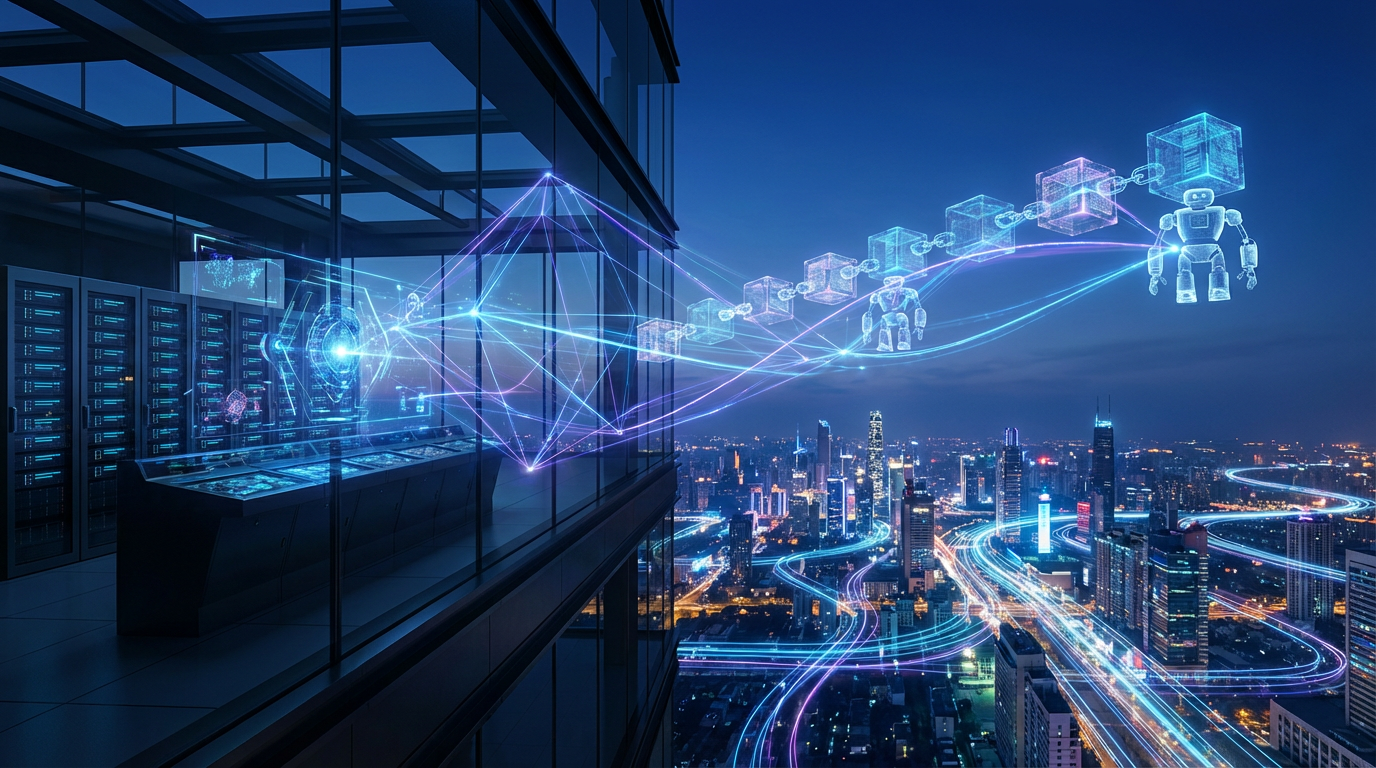
AI Agents & Blockchain: The Decentralized Future of Autonomous Intelligence
The convergence of Artificial Intelligence (AI) agents and blockchain technology is not merely an incremental advancement; it represents a foundational shift in how autonomous systems operate, interact, and secure their existence. This synergy promises to unlock unprecedented levels of trust, transparency, and efficiency for AI, moving beyond centralized, opaque models to a decentralized, verifiable paradigm. As AI agents become more sophisticated and pervasive, the need for robust, tamper-proof infrastructure to govern their actions, data, and economic interactions becomes paramount. Blockchain provides precisely this, offering a verifiable ledger, secure identity, and programmable execution environment that can elevate AI agents from isolated algorithms to trusted, interoperable entities within a global digital economy.
This article delves into the critical intersection of AI agents and blockchain, exploring the architectural foundations, transformative applications, and the inherent challenges that must be addressed to realize this decentralized future. We will dissect how blockchain can empower AI agents with enhanced security, verifiable autonomy, and economic agency, ultimately paving the way for a new era of intelligent, decentralized applications.
Key AI Agent & Blockchain Statistics
- The global AI market is projected to reach over $1.8 trillion by 2030, with a significant portion driven by autonomous agents and their integration into various industries (Source: Grand View Research, 2023).
- Over 60% of enterprise blockchain implementations are exploring integration with AI for enhanced data processing and decision-making capabilities (Source: IBM Blockchain Survey, 2022).
- The market for decentralized AI is estimated to grow at a CAGR of 35% from 2023 to 2028, indicating rapid adoption of blockchain-backed AI solutions (Source: MarketsandMarkets, 2023).
- Approximately 45% of AI developers cite data integrity and trust as major concerns in deploying autonomous systems, areas where blockchain offers direct solutions (Source: Deloitte AI Institute, 2023).
The Foundational Synergy: Why AI Agents Need Blockchain
AI agents, from simple chatbots to complex autonomous decision-making systems, are increasingly integrated into critical infrastructure and economic processes. However, their current centralized architectures present significant vulnerabilities: single points of failure, data manipulation risks, lack of transparency, and limited interoperability. Blockchain technology offers a compelling solution to these inherent weaknesses.
Enhancing Trust and Transparency
One of the primary benefits blockchain brings to AI agents is an immutable, auditable record of their actions, decisions, and data inputs. Every interaction, every data point processed, and every decision made by an AI agent can be logged on a distributed ledger, creating an unalterable history. This is crucial for applications where accountability and transparency are non-negotiable, such as autonomous vehicles, medical diagnostics, or financial trading bots.
Securing Data and Models
AI models are highly susceptible to data poisoning attacks or unauthorized tampering. Blockchain can secure the integrity of training datasets and AI models themselves. By hashing model parameters or data fingerprints onto a blockchain, any unauthorized modification becomes immediately detectable. Furthermore, decentralized storage solutions, often integrated with blockchain, can protect sensitive data from centralized breaches.
Enabling Verifiable Autonomy and Governance
True autonomy for AI agents requires a mechanism for verifiable execution and governance that doesn't rely on a single, fallible authority. Smart contracts on a blockchain can define the operational parameters, ethical guidelines, and decision-making logic for AI agents. These rules are transparent, self-executing, and tamper-proof, ensuring that agents operate within predefined boundaries without human intervention or external manipulation. This also facilitates decentralized autonomous organizations (DAOs) where AI agents can participate as members, executing proposals and managing resources.
Facilitating Economic Agency and Interoperability
For AI agents to function effectively in a decentralized economy, they need the ability to own assets, execute transactions, and be compensated for their services. Blockchain-based digital currencies and tokenization provide the infrastructure for AI agents to have their own wallets, engage in micro-transactions, and participate in peer-to-peer marketplaces. This economic agency, combined with standardized blockchain protocols, fosters seamless interoperability between different AI agents and decentralized applications (dApps), creating a more robust and interconnected ecosystem.
Architectural Frameworks for Decentralized AI Agents
Integrating AI agents with blockchain requires specific architectural considerations. Several frameworks are emerging to facilitate this synergy, each addressing different aspects of the interaction.
The [5]-Layer Decentralized AI Agent Framework
- Data Layer — Secure, decentralized storage (e.g., IPFS, Arweave) for training data and agent-generated data, with cryptographic proofs of integrity recorded on-chain.
- Blockchain Layer — The underlying distributed ledger (e.g., Ethereum, Polygon, Solana) providing immutable transaction records, smart contract execution, and tokenized incentives.
- Agent Logic Layer — The AI model and decision-making algorithms, potentially running off-chain but with critical parameters or execution proofs committed to the blockchain.
- Oracle Layer — Bridges between off-chain data/computation and on-chain smart contracts, enabling AI agents to access real-world information and trigger on-chain actions based on their analysis.
- Application Layer — User-facing interfaces and dApps that interact with the decentralized AI agents, providing inputs and receiving outputs.
Expert Insight: "The true power of AI agents on blockchain isn't just about security; it's about creating a new class of digital entities with verifiable economic and operational autonomy. We're moving from AI as a tool to AI as a participant in decentralized economies, demanding a shift in how we design and govern these systems. The challenge lies in balancing on-chain verifiability with off-chain computational efficiency."
Key Applications and Use Cases
The integration of AI agents with blockchain technology opens up a vast array of transformative applications across various sectors.
Decentralized Autonomous Organizations (DAOs) with AI Governance
AI agents can play a crucial role in DAOs, automating governance tasks, analyzing proposals, and even executing decisions based on predefined parameters. This can lead to more efficient, data-driven, and truly decentralized organizational structures.
Supply Chain Optimization and Transparency
AI agents can monitor supply chain data, detect anomalies, and predict disruptions, with all actions and data points immutably recorded on a blockchain. This enhances transparency, reduces fraud, and improves overall efficiency.
Decentralized Finance (DeFi) with Intelligent Automation
AI agents can power advanced DeFi strategies, execute complex trading algorithms, manage liquidity pools, and provide risk assessment, all within the transparent and auditable framework of blockchain-based protocols.
Healthcare Data Management and Research
AI agents can analyze vast amounts of medical data, identify patterns, and assist in diagnostics, while blockchain ensures the privacy, security, and integrity of patient records and research data.
Autonomous IoT Networks
IoT devices equipped with AI agents can interact, share data, and even transact autonomously on a blockchain, creating self-organizing and secure networks for smart cities, energy grids, and industrial automation.
Diagram: Decentralized AI Agent Ecosystem
[Off-Chain Data Sources] → [AI Agent (Off-Chain Computation)] → [Oracle Network (Data Verification)] → [Blockchain (Smart Contract Execution & Data Immutability)] → [Decentralized Application (User Interface)] → [Feedback Loop to AI Agent]
Challenges and Future Outlook
While the potential of AI agents on blockchain is immense, several challenges need to be addressed for widespread adoption.
Scalability and Computational Cost
Running complex AI models directly on-chain is computationally expensive and slow. Solutions involve off-chain computation with on-chain verification (e.g., zero-knowledge proofs, optimistic rollups) and the development of more efficient blockchain architectures.
Data Privacy and Confidentiality
While blockchain offers transparency, AI agents often deal with sensitive data. Homomorphic encryption, federated learning, and secure multi-party computation can be combined with blockchain to ensure data privacy while maintaining verifiability.
Oracle Problem and Trust
AI agents rely on external data. The integrity of this data, provided by oracles, is critical. Decentralized oracle networks with robust validation mechanisms are essential to prevent manipulation.
Regulatory and Ethical Frameworks
As autonomous AI agents gain more agency, clear regulatory and ethical guidelines are needed to govern their behavior, accountability, and potential impact on society. Blockchain can provide the infrastructure for enforcing these rules.
Interoperability Standards
For a truly decentralized AI ecosystem, standardized protocols for AI agent communication, data exchange, and smart contract interaction across different blockchains are crucial.
| Integration Strategy | Best For | Difficulty | ROI Potential |
|---|---|---|---|
| On-Chain AI (Limited) | Simple logic, high trust | Hard | Medium |
| Off-Chain AI with On-Chain Proofs | Complex models, verifiable execution | Medium | High |
| Decentralized Oracles for AI | Real-world data access | Medium | High |
| AI-Powered DAOs | Automated governance, resource allocation | Hard | Very High |
| Tokenized AI Services | Monetization of AI models/data | Easy | Medium |
The future of AI agents on blockchain is one of increasing autonomy, transparency, and economic participation. As these technologies mature, we can expect to see a new generation of intelligent, self-sovereign digital entities that redefine industries and create novel forms of value.
Frequently Asked Questions
What is an AI agent in the context of blockchain?
An AI agent in the context of blockchain is an autonomous software program that uses artificial intelligence to perform tasks, make decisions, and interact with other entities, with its actions and data often recorded and verified on a decentralized ledger. This integration enhances trust, transparency, and security for the agent's operations.
How does blockchain enhance the security of AI agents?
Blockchain enhances AI agent security by providing an immutable ledger for recording actions, decisions, and data, making tampering detectable. It can also secure training data and model parameters through cryptographic hashing, preventing unauthorized modifications and data poisoning attacks.
Can AI agents own assets or transact on a blockchain?
Yes, AI agents can own assets and transact on a blockchain. Through smart contracts and tokenization, AI agents can be assigned digital wallets, hold cryptocurrencies or NFTs, and execute peer-to-peer transactions, enabling them to participate in decentralized economies and be compensated for their services.
What are the main challenges for integrating AI agents with blockchain?
The main challenges include scalability and computational cost for on-chain AI, ensuring data privacy and confidentiality for sensitive information, addressing the oracle problem for reliable off-chain data, developing clear regulatory and ethical frameworks, and establishing interoperability standards across different blockchain networks.
What role do smart contracts play in decentralized AI agents?
Smart contracts play a crucial role by defining the operational parameters, ethical guidelines, and decision-making logic for AI agents in a transparent, self-executing, and tamper-proof manner. They enable verifiable autonomy, govern interactions, and facilitate economic transactions for AI agents within a decentralized environment.