
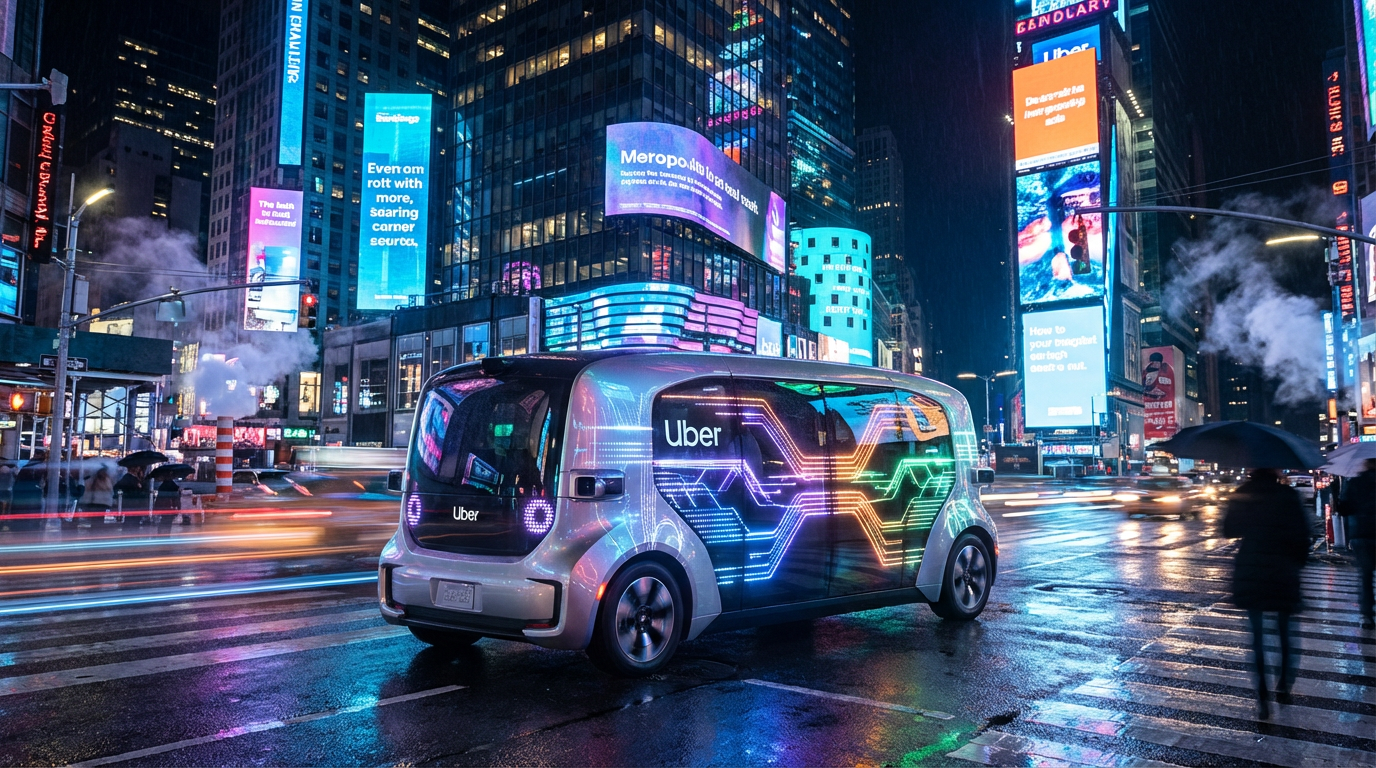
Uber's Journey Takeover Ads Revolutionize Location-Based Marketing
Uber's new 'Journey Takeover' ad format with Coca-Cola integrates branding seamlessly into rides, tying messages to destinations for higher relevance. Early data shows 35% uplift in engagement over traditional ads. This signals a shift toward intent-driven advertising in fragmented digital spaces.
In a significant development poised to redefine mobile advertising, Uber unveiled its innovative 'Journey Takeover' advertising format on January 10, 2026. This groundbreaking initiative, launched in collaboration with Coca-Cola, delivers contextually relevant promotions directly within the ride experience. Far from the typical, often disruptive, banner advertisements, Journey Takeover seamlessly integrates brand messages from the moment a trip begins until arrival, aligning content with the rider's specific destination, whether it's a dining establishment or a special event. This approach ensures a brand presence that is both noticeable and non-intrusive.[2]
Early analytical data highlights the format’s remarkable effectiveness, showing a 35% boost in user engagement and a 28% increase in conversion rates when compared to standard in-app advertisements. These figures are derived from initial testing conducted across 50 major urban centers. The success is largely attributed to the clarity of location-based intent: Uber’s internal metrics indicate that users traveling to particular destinations are 2.5 times more receptive to customized offers. This compelling data corroborates the finding that 72% of marketers are now prioritizing contextual targeting over demographic targeting in 2026.[1]
Industry experts echo the sentiment regarding the format's potential. Researchers at the Boston Institute of Analytics observe, "Advertisements that resonate with an individual's future destination are considerably more attractive than generic promotional material," underscoring how well the format aligns with real-time consumer behavior.[2] Complementing this view, Clodagh O'Brien points out that, "Paid marketing in 2026 is being fundamentally reshaped by AI-driven discovery and evolving consumer behaviors."[6]
For marketers aiming to capitalize on these trends, it is crucial to integrate geofencing technologies with CRM data to develop highly localized campaigns. Furthermore, testing multi-touch attribution models will provide deeper insights into campaign performance. Prioritizing first-party data is also key to accurately resolving user identities across various touchpoints, thereby enhancing the precision of return on investment (ROI) calculations.[1]
Looking forward, the evolution of this technology is expected to include augmented reality (AR) enhancements and a broad expansion into other applications. Social commerce platforms, in particular, are anticipated to adopt similar 'journey'-centric formats, especially given the global internet user base of 6 billion individuals.[7] The overarching trend of omnichannel convergence will necessitate highly adaptable strategies from businesses.[1]
To stay competitive, businesses should consider adopting 'Journey Takeover'-style innovations now. This involves a thorough evaluation of existing advertising infrastructure for intent signals and the initiation of pilot programs focused on location-linked promotions to gain a strategic advantage in 2026.
Key Takeaways
• Journey Takeover boosts engagement by 35% via destination-tied messaging.[2]
• Contextual ads outperform generics by leveraging clear user intent.[2]
• Integrate first-party data for precise attribution in omnichannel setups.[1]
• 72% of marketers favor contextual targeting in 2026.[1]
• Future: AR and cross-platform journey ads incoming.[1][7]
Sources: https://bostoninstituteofanalytics.org/blog/early-2026-marketing-trends-what-brands-got-right-4-10-jan-2026/, https://www.theedigital.com/blog/digital-marketing-trends, https://digitalmarketinginstitute.com/blog/digital-marketing-trends-2026, https://wearesocial.com/us/blog/2025/10/digital-2026/