
In-Depth Guide
7 min read
April 9, 2026
Decentralized AI Infrastructure: Powering the Next Generation of AI
# Decentralized AI Infrastructure: Powering the Next Generation of AI The rapid advancements in artificial intelligence demand an equally robust and adapt
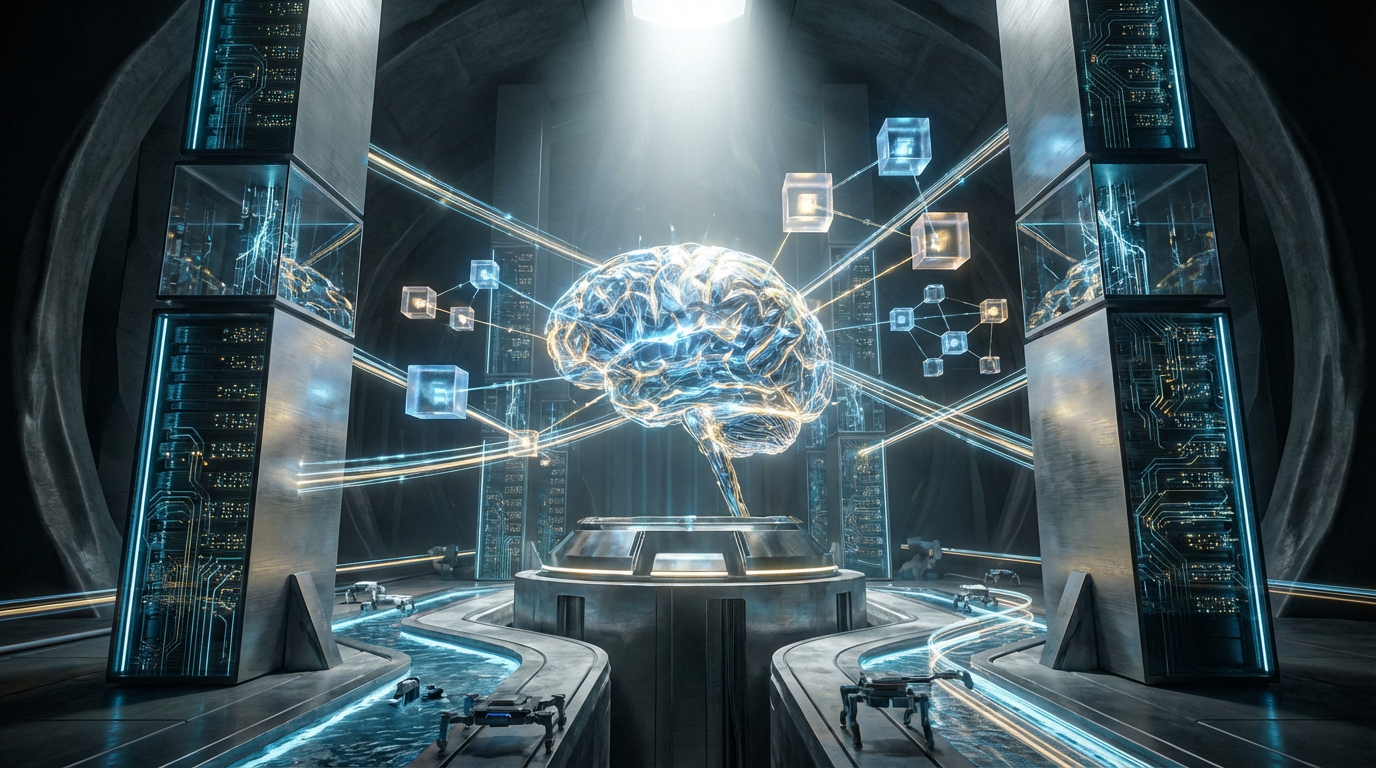
Decentralized AI Infrastructure: Powering the Next Generation of AI
The rapid advancements in artificial intelligence demand an equally robust and adaptable infrastructure. Traditional centralized cloud computing, while powerful, presents inherent limitations for the future of AI, particularly concerning data privacy, censorship resistance, and equitable access to computational resources. This is where decentralized AI infrastructure emerges as a transformative solution. By distributing computational power, data storage, and algorithmic execution across a network of independent nodes, decentralized AI infrastructure promises a more resilient, transparent, and democratic foundation for AI development and deployment. This paradigm shift is crucial for supporting the burgeoning ecosystem of decentralized AI agents and fostering truly autonomous intelligence.
Key Decentralized AI Infrastructure Statistics
- The global market for decentralized cloud computing, a core component, is projected to reach $10 billion by 2028 (Source: Grand View Research).
- Over 70% of AI developers express concerns about data privacy in centralized AI environments (Source: Deloitte AI Survey).
- Decentralized GPU networks have seen a 300% increase in computational resource utilization in the past year (Source: The Block).
- The cost of AI model training can be reduced by up to 50% using decentralized compute resources compared to traditional cloud providers (Source: Golem Network analysis).
The Imperative for Decentralized AI Infrastructure
The limitations of centralized AI infrastructure are becoming increasingly apparent as AI models grow in complexity and their applications become more pervasive. Centralized systems are prone to single points of failure, making them vulnerable to outages and cyberattacks. They also concentrate power and data in the hands of a few corporations, raising concerns about data monopolies, censorship, and algorithmic bias. Decentralized AI infrastructure directly addresses these issues by distributing control and resources, creating a more robust and equitable ecosystem.
Core Components of Decentralized AI Infrastructure
Decentralized AI infrastructure is not a single technology but a stack of interconnected decentralized services. These typically include:
- Decentralized Compute Networks: Platforms that allow users to rent out their unused computational power (GPUs, CPUs) to others, creating a global, distributed supercomputer for AI model training and inference.
- Decentralized Storage Solutions: Immutable and censorship-resistant storage networks (e.g., IPFS, Arweave) for AI datasets, models, and agent states, ensuring data integrity and availability.
- Blockchain & Smart Contracts: The foundational layer for coordination, governance, payment, and verifiable execution of AI tasks. Smart contracts enable trustless interactions between AI agents and resource providers.
- Decentralized Oracles: Bridges that securely connect real-world data to blockchain-based AI systems, ensuring that AI agents can access accurate and verified external information.
| Component | Centralized Equivalent | Decentralized Advantage |
|---|---|---|
| Compute | AWS, Google Cloud | Distributed, cost-effective, censorship-resistant |
| Storage | S3, Azure Blob | Immutable, verifiable, user-owned data |
| Coordination | Centralized APIs | Trustless, transparent via smart contracts |
| Data Oracles | Proprietary APIs | Verifiable, secure, external data feeds |
| Governance | Corporate control | Community-driven, transparent DAOs |
Empowering Decentralized AI Agents and Applications
Decentralized AI infrastructure is the backbone for the next generation of AI applications, particularly those involving autonomous agents. These agents, such as those discussed in the context of AI agents blockchain, require an environment where their operations are verifiable, their data is secure, and their execution is guaranteed without reliance on a single, fallible entity. For example, a decentralized AI agent performing complex financial analysis could leverage a decentralized compute network for its heavy processing, store its findings on a decentralized storage solution, and use smart contracts on a blockchain to execute trades based on its analysis. This entire process would be auditable and transparent, building unprecedented trust in AI-driven decisions.
5-Step Framework for Building on Decentralized AI Infrastructure
- Identify Decentralized AI Use Case — Determine if your AI application benefits from decentralization (e.g., requires censorship resistance, data privacy, trustless execution, or distributed compute).
- Select Core Decentralized Stack — Choose appropriate decentralized compute, storage, and blockchain platforms based on your project's specific needs for scalability, cost, and functionality.
- Design for On-Chain/Off-Chain Interaction — Architect your AI model to leverage off-chain decentralized compute for heavy lifting, while using blockchain for verification, coordination, and state management via smart contracts.
- Integrate Decentralized Oracles — Implement secure oracle solutions to feed your AI models with reliable, real-world data, ensuring the integrity of inputs for decision-making.
- Establish Decentralized Governance — Plan for community-driven governance mechanisms (e.g., DAOs) for future upgrades, parameter changes, and dispute resolution, ensuring the long-term sustainability and fairness of your decentralized AI system.
The Economic and Ethical Implications
The shift to decentralized AI infrastructure has profound economic and ethical implications. Economically, it democratizes access to computational resources, allowing smaller teams and individual developers to train and deploy sophisticated AI models without prohibitive costs. This fosters innovation and reduces the monopolistic tendencies of large tech companies. Ethically, decentralized infrastructure promotes transparency and auditability, making it easier to identify and mitigate algorithmic biases. By distributing control, it also reduces the risk of AI being used for malicious purposes by a single powerful entity, aligning with the principles of responsible AI development.
Expert Insight: "The real innovation in decentralized AI infrastructure isn't just about cheaper compute; it's about shifting the power dynamic. We're moving from a world where a few gatekeepers control AI's development to one where communities can collectively build, own, and govern intelligent systems. This is fundamental to ensuring AI serves humanity, not just corporate interests."
Furthermore, the ability to trace data provenance and model updates on an immutable ledger significantly enhances accountability. This is particularly important for decentralized AI agents operating in sensitive domains like finance or healthcare, where verifiable decision-making is paramount. The transparency offered by this infrastructure helps build public trust in AI systems, a critical factor for their widespread adoption.
Diagram: Decentralized AI Infrastructure Stack
[AI Application/Agent Layer] → [Decentralized Compute Network] → [Decentralized Storage Network] → [Blockchain/Smart Contract Layer] → [Decentralized Oracle Network] → [Real-World Data Sources]
Challenges and Future Directions
While the promise of decentralized AI infrastructure is compelling, several challenges must be addressed. Scalability remains a significant hurdle; processing vast AI datasets and complex models on decentralized networks can be computationally intensive and slow. Interoperability between different decentralized components (compute, storage, blockchain) also needs further standardization. User experience for developers and end-users can be more complex than centralized alternatives, requiring better tooling and abstraction layers. However, ongoing research and development in areas like sharding, layer-2 solutions, and specialized AI-focused blockchains are continuously improving performance and usability.
The future of decentralized AI infrastructure will likely see greater integration of privacy-preserving technologies like homomorphic encryption and zero-knowledge proofs, allowing AI models to train on encrypted data without ever exposing sensitive information. We can also expect more sophisticated decentralized autonomous organizations (DAOs) to govern these infrastructures, ensuring fair resource allocation and community-driven development. The journey is complex, but the foundational elements are in place to build a truly open, resilient, and ethical AI future.
Frequently Asked Questions
What is decentralized AI infrastructure?
Decentralized AI infrastructure refers to a distributed network of computational resources, data storage, and coordination mechanisms (like blockchain) that power AI applications without relying on a single central authority. It aims to provide a more resilient, transparent, and equitable foundation for AI.
Why is decentralized AI infrastructure important?
It's important because it addresses critical limitations of centralized AI, such as single points of failure, data privacy concerns, censorship, and monopolistic control. It democratizes access to AI resources and fosters greater transparency and trust in AI systems.
How does blockchain contribute to decentralized AI infrastructure?
Blockchain serves as the foundational layer, providing an immutable ledger for coordination, governance, and verifiable execution of AI tasks. Smart contracts on blockchain enable trustless interactions, payments, and the secure management of AI agent operations and data.
What are the main components of decentralized AI infrastructure?
The main components typically include decentralized compute networks (for processing), decentralized storage solutions (for data and models), blockchain and smart contracts (for coordination and governance), and decentralized oracles (for real-world data feeds).
Can decentralized AI infrastructure reduce AI development costs?
Yes, decentralized AI infrastructure can significantly reduce AI development costs, particularly for model training and inference. By leveraging peer-to-peer networks of unused computational resources, developers can often access GPU/CPU power at a fraction of the cost of traditional centralized cloud providers.
Key Takeaways
- Decentralized AI infrastructure distributes compute, storage, and coordination, overcoming limitations of centralized AI.
- It provides a resilient, transparent, and censorship-resistant foundation for AI development and deployment.
- Blockchain, smart contracts, and decentralized oracles are critical components enabling trustless AI operations.
- This infrastructure empowers decentralized AI agents and democratizes access to AI resources.
- Challenges like scalability and interoperability are being addressed, paving the way for an ethical and open AI future.